
3 Core differences between Sandy Pickle & Pickleball:
1. Court Dimensions:
Pickleball: Each baseline is set 22′ from the net, with a non-volley zone (kitchen) line at 7″ from the net. The court width is 20′ from sideline to sideline, with a 10′ centerline.
Sandy Pickle: Each baseline is set 15′ from the net, with a non-volley zone (kitchen) marker set 3′ from the center of the net. The court width is 13′ 6″ for singles and 16′ 8″ for doubles wide (the kitchen marker also defines the centerline).
*Court dimensions are often modified to accommodate for taller or shorter players, various disabilities, more or less challenging court coverage, etc.
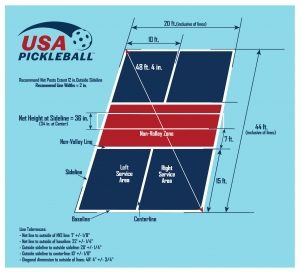
2. Net Height
Pickleball: A 3′ net is standard for recreational play; official IPA rules call for a net height of 36″ on each end and 34″ at the center.
Sandy Pickle: Long volley rallies are one of the most exciting aspects of Sandy Pickle, and a higher net helps keep the ball in the air longer. For recreational play, the adjustable net should be set to the approximate height of the tallest player on the court. For tournament play, height divisions are recommended.
3. Two-Bounce Rule
Pickleball: The ball must be allowed to bounce once before returning a serve, and again on the server’s side of the court before their return shot.
Sandy Pickle: Because the game is played on sand or grass, bounces are not possible; each shot is made on the fly.

How To Play Sandy Pickle:
After setting up the court and adjusting the net to the approximate height of the tallest player, begin play according to the rules below.
Serving & Scoring:
• Determine which singles player or doubles team will serve first – this is often determined by having the player or team with the height advantage serve second.
• The person serving must stand behind the baseline; underhand and overhead serves are both legal, with each style having its advantages and disadvantages*. If a serve lands within the kitchen or outside the court boundaries, the point is lost.
*See game strategies section for more details on serving styles.
• Games are played to 11 points, and a point is only awarded when the person or team serving wins the point. If the team not serving wins the point, they take over the serve but do not receive a point. The player serving will continue to serve until they lose the point. Unlike pickleball, in doubles play, the serve alternates sides at the end of each players serving opportunity, and the doubles teammate will be serve when they win the point on the receiving end. Serves alternate until either player or team reaches 11 points. In Sandy Pickle, the “win by 2 points” rule is optional.
Net Height
Pickleball: A 3′ net is standard for recreational play; official IPA rules call for a net height of 36″ on each end and 34″ at the center.
Sandy Pickle: Long volley rallies are one of the most exciting aspects of Sandy Pickle, and a higher net helps keep the ball in the air longer. For recreational play, the adjustable net should be set to the approximate height of the tallest player on the court. For tournament play, height divisions are recommended.
Two-Bounce Rule
Pickleball: The ball must be allowed to bounce once before returning a serve, and again on the server’s side of the court before their return shot.
Sandy Pickle: Because the game is played on sand or grass, bounces are not possible; each shot is made on the fly.
Comparison of Rules Shared By Both Games:
Non-Volley Zone (“Kitchen”)
Pickleball: No volleying is permitted within the non-volley zone. This rule prevents players from executing smashes from a position within the zone. When volleying the ball, the player may not step on or over the line. It is a fault if the player’s momentum causes the player or anything the player is wearing or carrying to touch the non-volley zone. It is a fault even if the ball is declared dead before the player touches the zone. A player may be in the non-volley zone at any other time. The non-volley zone is sometimes referred to as the kitchen.
Sandy Pickle: Because the game is played on sand or grass, bounces are not possible; each shot is made on the fly.
Boundary Lines
Pickleball: The ball must be allowed to bounce once before returning a serve, and again on the server’s side of the court before their return shot.
Sandy Pickle: Because the game is played on sand or grass, bounces are not possible; each shot is made on the fly.
Equipment
Pickleball: The ball must be allowed to bounce once before returning a serve, and again on the server’s side of the court before their return shot.
Sandy Pickle: Because the game is played on sand or grass, bounces are not possible; each shot is made on the fly.
Scoring
Pickleball: Both players on the serving team are allowed to serve, and a team shall score points only when serving. A game is played to eleven points and a team must win by two points. Rallies are lost by failing to return the ball in bounds to the opponent’s court before the second bounce, stepping into the non-volley zone and volleying the ball, or by violating the double-bounce rule. The hand is considered an extension of the paddle. The player loses the rally if the ball hits any other part of his body or clothing.
Sandy Pickle: Because the game is played on sand or grass, bounces are not possible; each shot is made on the fly.
Official Pickleball Rulebook With Notations
Click Here to download a PDF copy of the official 2021 International Federation of Pickleball (IPA) Rulebook, annotated with comments with respect to how each rule applies in Sandy Pickle.
Scoring
Pickleball: The ball must be allowed to bounce once before returning a serve, and again on the server’s side of the court before their return shot.
Sandy Pickle: Because the game is played on sand or grass, bounces are not possible; each shot is made on the fly.
Court Dimensions
Pickleball: 3′ net, 22′ deep including a 7′ kitchen, and 20′ wide with a 10′ centerline.
Sandy Pickle: 5′ net, 15′ deep including a 4′ kitchen, and 13′ (singles) or 15′ (doubles) wide with no centerline.
*In recreational play, the net height and court size are often modified to accommodate for taller or shorter players, various disabilities, more or less challenging court coverage, etc.
How it started…
Lorem ipsum dolor sit amet, consectetuer adipiscing elit. Aenean commodo ligula eget dolor. Aenean massa. Cum sociis natoque penatibus et magnis dis parturient montes, nascetur ridiculus mus. Donec quam felis, ultricies nec, pellentesque eu, pretium quis, sem. Nulla consequat massa quis enim.
How it started…
Lorem ipsum dolor sit amet, consectetuer adipiscing elit. Aenean commodo ligula eget dolor. Aenean massa. Cum sociis natoque penatibus et magnis dis parturient montes, nascetur ridiculus mus. Donec quam felis, ultricies nec, pellentesque eu, pretium quis, sem. Nulla consequat massa quis enim.
How it started…
Lorem ipsum dolor sit amet, consectetuer adipiscing elit. Aenean commodo ligula eget dolor. Aenean massa. Cum sociis natoque penatibus et magnis dis parturient montes, nascetur ridiculus mus. Donec quam felis, ultricies nec, pellentesque eu, pretium quis, sem. Nulla consequat massa quis enim.
How it started…
Lorem ipsum dolor sit amet, consectetuer adipiscing elit. Aenean commodo ligula eget dolor. Aenean massa. Cum sociis natoque penatibus et magnis dis parturient montes, nascetur ridiculus mus. Donec quam felis, ultricies nec, pellentesque eu, pretium quis, sem. Nulla consequat massa quis enim.
How it started…
Lorem ipsum dolor sit amet, consectetuer adipiscing elit. Aenean commodo ligula eget dolor. Aenean massa. Cum sociis natoque penatibus et magnis dis parturient montes, nascetur ridiculus mus. Donec quam felis, ultricies nec, pellentesque eu, pretium quis, sem. Nulla consequat massa quis enim.
19,90$
Starting Price
298.000
active members
87 Studios
around the world
Another Kickstarter Success!